Good Grief
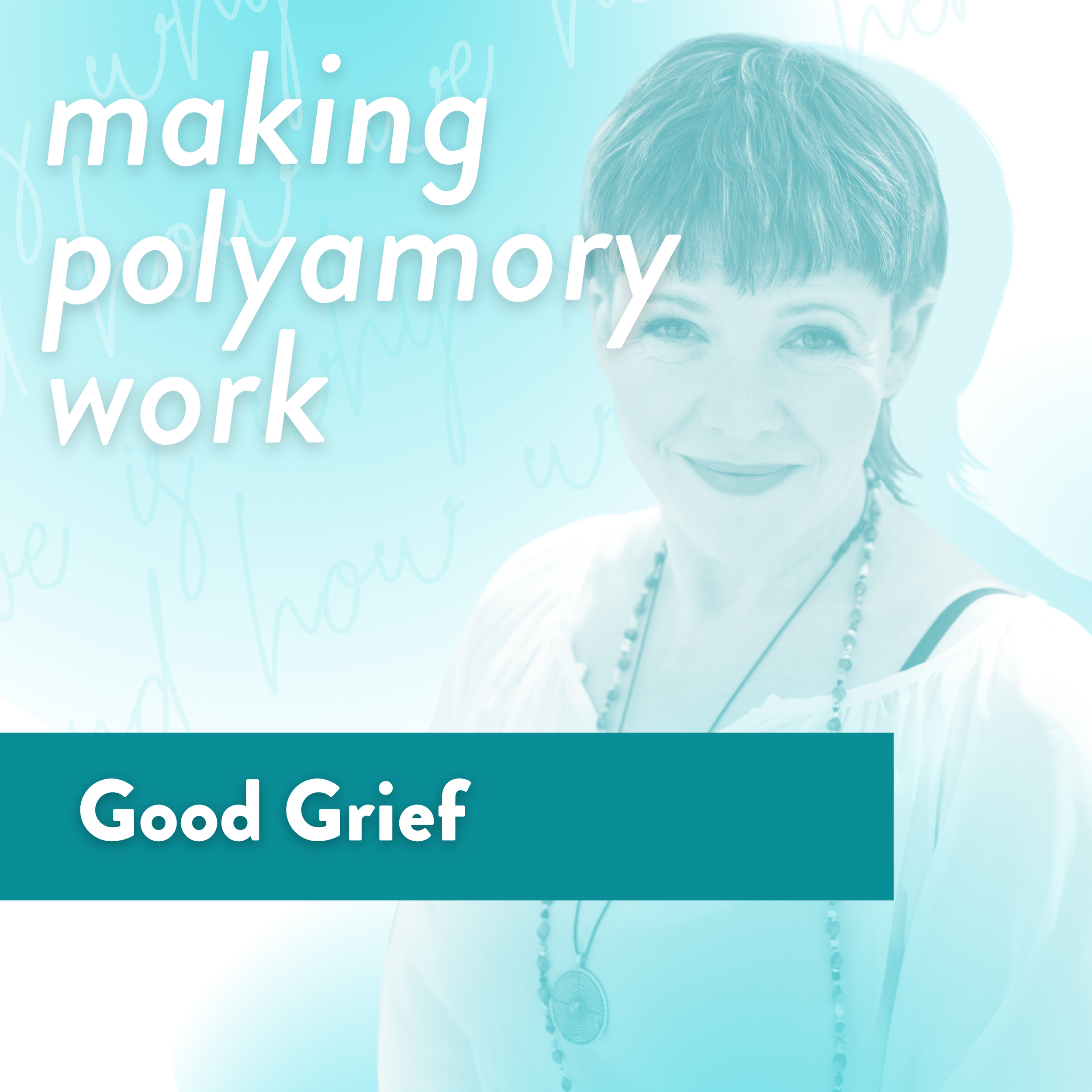
Libby talks about feeling grief and letting it move through you rather than being in a state of constant fixing as a way of avoiding it.
Also! Libby has created a workbook based on the most popular episodes of the podcast — with simple practices and reflection questions so that you can apply this stuff to your life.
Go to https://libbysinback.com/workbook to get your copy.
Transcript
Libby Sinback:
Foreign. Welcome to Making Polyamory Work. Hi, I'm Libby Sinback and I want to thank you for being with me today. I am committed to helping people who live and love outside the status quo have extraordinary relationships because relationships are at the core of our well being as humans. I think love is why we're here and how we heal. So today's episode is one that I actually recorded a while back. And yet I'm recording this, this intro on January 15, 2026. And it's just so heavy right now.
Libby Sinback:
My heart is heavy with the weight of the world. Last week, the world lost Renee Goode, who was publicly executed by ICE agents in Minneapolis. And there's so many other things that I am grieving. Big things, big world level atrocities happening all around us. And this episode isn't about that. This episode is about actually little griefs. Little griefs that maybe we don't allow ourselves to feel and instead we go straight to fix. And the invitation here, which I hope you will explore with me today, is just what if we feel first and then figure out what to do after that.
Libby Sinback:
I want to give a shout out to one of my teachers, Julianne Taylor Shore, who has really shown me and taught me so much of what I am going to share in this episode. So I hope it supports you during this moment and other moments. Now we'll get into the episode. There's two phrases that I hear either spoken or unspoken in my work with clients. There's the maybe we shoulds and the if onlys. The maybe we shoulds are more out loud. Things like, you know, maybe we should stop being polyamorous. Maybe I should see her less often.
Libby Sinback:
Maybe we should separate for a while. Maybe I shouldn't do any more overnights. Maybe we should only date together as a couple. Maybe. Maybe. And it's a fix it phrase. It's when you're facing something difficult and you want it to change. And then there are the if onlys.
Libby Sinback:
Those are usually unspoken. If only my partner wouldn't get so upset every time I go on a date. If only my partner would get out of the house more. If only my metamor liked me. If only my partner were open to polyamory. If only he'd give me a second chance. If only my partner would just not date so many people. If only they would just be more present instead of always on their phone.
Libby Sinback:
As a coach, I see my job as helping my clients get clear on what they want, usually relationally. And then we work together to figure out how to get there, we look together at what might be blocking them, what might be standing in the way of what they want, and also what might be on the way to get there. What a lot of people don't expect to be on the way is grief. Nobody wants to talk about this. I swear, nobody wants to talk about it in my sessions either, let alone allow themselves to feel it. They want, understandably, to figure out solutions. They want to build skills. They want to understand themselves better so that they can improve.
Libby Sinback:
They want to get their partner to change. That's a true story. They want clarity. This one's my favorite. And look, my clients and I do all of that for sure. But sometimes what is really happening is avoiding grief. How do you know if you're avoiding grief or if you are actually moving towards something that you want? I don't know that you do, but I will say this. If you're in pain and you're just looking for a solution to make the pain go away, it might be worth slowing down a little bit and seeing if you're avoiding grief.
Libby Sinback:
So what even is grief? Well, the Oxford Dictionary defines grief as a deep sorrow, especially that is caused by someone's death. I don't love this definition and I'll tell you why. First of all, most people think that the only time you feel grief is if someone dies. And that any other time that you're feeling grief, you shouldn't be feeling grief, which is a big part of the problem. And the second thing is that I think grief is way more than deep sorrow. I think it's a much more complex. It's not even an emotion. It's like a cluster of emotions.
Libby Sinback:
I like Julianne Taylor Schur's definition better. She basically said that grief is love, which she defines as a recognition of the great worth that someone or something has, plus a reality that doesn't fully reflect that love. So it's love plus a hard reality equals grief. I also like to think about it as hope and potential not lining up and how things shake out. Grief is loss. Grief is disappointment. Grief is unfairness. Grief touches our sense of justice, our sense of meaning and order in the world.
Libby Sinback:
Grief leaves us spinning trying to make sense of how, how can this be? I'm not ready to let go of whatever it was I was holding onto. And while of course, death and also even like breaking up are big, clear losses where it feels obvious that grief is the only thing that you can feel. Here are some other examples of things that I've seen that I think also deserve grief. I've never had a good sex life with my primary partner. And now that I've been with other people, I know how good it can be. I am deeply in love with two people who can't stand each other. I don't have the capacity to give this relationship the time, energy, and attention that matches the love that I feel. My partner and I see this relationship really differently and want different things from it.
Libby Sinback:
They're my only partner and a huge anchor to me, and they have another anchor partner. And I am one of many people they prioritize and spend time with. I want to escalate into cohabiting in a more anchored dynamic. And my partner wants to remain solo and independent. My partner doesn't want to be monogamous with me. My partner is no longer attracted to me and still wants to live together and raise our kids together. My partner is okay with other sexual partners, but not okay with me falling in love. But I'm not interested in having sex with other people.
Libby Sinback:
If I'm not in love with them, I could go on. And all of these situations are so, so, so hard. And I think it's so common when people talk about these situations with their friends. You know, they're immediately like, well, just don't do that or just change it. You know? And I think that's often what happens when we ourselves are faced with something so, so hard, is we just want to fix it. We have a hope that maybe we can just find some strategy or just say something that's just gonna unlock this really, really hard reality. Or maybe if we blame ourselves or we blame the other person hard enough, then one of us will change. I think all of that is in service of avoiding grief.
Libby Sinback:
And it makes sense. Grief is overwhelming. Sometimes it asks you to slow down and sometimes stop altogether. It asks you to weep. And I don't think our culture has an easy time with either of those things slowing down or weeping. I think that's why maybe we only associate grief being okay if it is a big loss, like a death or a breakup, because then it's like, okay, well, everybody understands that. And so then I'm allowed to slow down. Then I'm allowed to cry.
Libby Sinback:
And people will understand. They won't try to fix my problem because there's no fixing it. And honestly, I think sometimes when we're faced with an unfixable problem in our relationships, people move really quickly towards breaking up or separating or making some kind of significant transition, because at least then the loss feels more clear. It's like we can't allow someone we love to cause us grief and not also pull away from them and the situation. Like, we can't stay connected to someone when there's grief, when there's pain like that, like, that's too hard. And also when we. We do that, people look at us like we're crazy. Like, look, you're obviously grieving.
Libby Sinback:
You shouldn't be grieving when you're with somebody. So better just not be with them and then grieve then. But what I've learned is that grief exists inside of every single relationship that I have ever been in, including the ones I'm currently in. And I. I want to normalize that. Like, I think we have this idea that if we find the right person or the right situation, that somehow we're going to be insulated from heartbre. And I think it's the opposite. I feel like when we connect ourselves, when we hold somebody deeply, that is widening the ways in which we can experience heartbreak.
Libby Sinback:
Now, sometimes the grief is little. Like, you know, ugh, right now my partner's in a bad mood and is projecting their shit onto me. And they won't be able to talk to me rationally until they've gotten some fresh air or maybe some exercise. So I'm gonna have to wait for closeness and understanding because it's just not there right now. And sometimes it's. It's big. This relationship is never going to be what I was hoping it would be. And I have to grieve that dream that I had for it for me and for the life that I wanted to have with this person.
Libby Sinback:
And I think it's so common that we do everything we can to avoid both kinds of grief. We. When our partner's being grumpy, we either, like, pursue them and try to fix it and try to change their mood, or we pull away because we can't hang with the pain of them being where they are and us not getting what we are hoping for in that moment. And then I think it's really common for people to feel like they need to end a relationship if it's not meeting their hopes and dreams, rather than just grieve what could be and look and see if there's possibility and joy in what actually is. And often enough, as in the second example, a big way that people avoid grief when they do decide to break up is to make the other person the bad guy. Don't believe me? Well, here, try this out. Take a situation where you felt wronged in some way. It could be big it could be small.
Libby Sinback:
And I want you to just take in one hand and, like, pour into that hand all of the pain that situation caused you. And in the other hand, I actually want you to pour in all the pain that the other person may have been also going through that led them to hurt you. Really hang with it for a minute. Try to hold both. And in the hand with your pain, I want you to also hold that you're not perfect, and you probably didn't do everything right in that situation, and that doesn't mean you deserved the pain that was caused. And in the other hand, with the other person's pain, I want you to hold that they, too, are flawed and they caused hurt and maybe even harm, and that they may have been just as much a mix of flaws and virtues as you are. Most people, when they hold both like this, I really want you to just stay with it for a second. Usually what happens when I ask people to do this is they immediately access greater compassion for themselves and for the other person.
Libby Sinback:
And then very quickly after that, they feel really sad when there's no one to blame. When there's no bad guy, then there's just grief. There was so much love here. There was so much value in me as a person, and that value wasn't honored by what happened. That doesn't mean anybody did anything wrong. But, boy, it's sad. And y', all, I get it. Nobody wants to feel sad.
Libby Sinback:
One of my sweet clients told me, libby, if I let myself cry, all the tears I have to cry, I'm not going to get out of bed for a week. And it's true, sadness slows us down. And in a capitalist society, there is often not time to slow down. Or at least we don't believe there's time to slow down. We have all this shit to do because we're all so used to keeping it moving. And so when sadness comes, we don't know what to do. And neither do other people. They think something's wrong and must be fixed.
Libby Sinback:
We think something's wrong and what? And must be fixed. And sometimes that's true, but it really doesn't help when we're dealing with grief, because there's nothing wrong. There are just so many situations where grief is actually the appropriate and reasonable response to the situation. But we also don't like grief, not just because it slows us down, but because it's unpredictable. One day you might be sad, but then the next day you might be angry. And then the next day you're trying to figure out how to make reality different. And then one day, you're pretending it's not happening. And then sometimes you might find your way into some acceptance.
Libby Sinback:
And, yeah, these are the five stages of grief, but they're not linear. And, y', all, here's the thing, really. The healing comes when you surrender to that grief, when you allow yourself to sink all the way into sadness and even hopelessness. I know. I'm serious, though. When you go all the way into that dark cave, this shouldn't have happened, but it did. This shouldn't be this way, but it is. There's nothing that can be done.
Libby Sinback:
There's no way back. I can't undo this. I can't change it. And accepting it is breaking my heart. The irony is, as much as we don't know how to be with grief, with ourselves or with other people, it is absolutely something we shouldn't go through alone. And so when I'm sitting with my clients and we find ourselves in this hard place, it's very tender, and I just try to hold them in it. And y', all, I take my own medicine here. I have made my own project to grief really well, and it sucks.
Libby Sinback:
But what I can report to you is that you don't have to stay in bed for a week. I generally don't think that that's what grief is. Grief is not depression. Okay. And I actually really. I want to pause here and just make a quick distinction between grief and depression. So when you're depressed, you may actually be stuck in a state of pain where there's some inescapable pain either inside of you or outside of you. And your body's very healthy, normal response is to downregulate everything so you don't feel as much.
Libby Sinback:
You don't feel motivated for much, because if you activated your system more, then you would be feeling the pain. Grief isn't that. Grief is actually like, surrendering to the pain and allowing it to wash through you and allow you to emerge changed on the other side. And actually, let me just take that back. Let me just walk that back for a second. What I said about, like, maybe you wouldn't need to stay in bed for a week, because, like, what if you actually just did need to stay in bed for a week? What if the heartbreak that you were feeling in your body felt that big, that to honor that pain is to lie down with it for a week? We're so afraid of slowing down and stopping because we're worried we're gonna, like, lose our momentum, that we don't give our sorrow. We don't give our grief the space that it needs. And sometimes that actually helps us get up and go again.
Libby Sinback:
I keep thinking about the movie Inside out whenever I talk about grief, because I think Inside out is exactly about grief avoidance. If you want to know both how you might be avoiding grief and also how to grieve and also how to help someone grieve. Inside out has instructions for all of that. And one of my favorite scenes in the movie is when Bing Bong has just had his wagon, like, cast into the place where all of the memories dissolve and are forgotten forever. And he's heartbroken. And, you know, and the two other characters, Sadness and Joy, they really need Bing Bong to help them. And. And so Joy's, like, trying to cheer him up, like, right away, like, how can I make this better? Ah, it's not that bad.
Libby Sinback:
Ah, I'm gonna just tickle you. And nothing, nothing works. Nothing makes him feel better. And in fact, he just gets more and more sullen. But then Sadness comes and just sits with him and just shows empathy, just says what he must be feeling, and he goes, yes, yes. And he wails, he cries. And of course he cries little bits of candy, which is just adorable, but he wails and he releases it. And then on the other side, he's like, okay, I'm ready now.
Libby Sinback:
I'm ready to go. Let's go. But okay, okay. Maybe the possibility of staying in bed for a week is gonna really hurt me in trying to sell you on grieving. Maybe that just feels too scary. And so I just want to offer you some other ways for you to give yourself room to grieve rather than avoid it. First of all, I think it's useful to find some supportive friends or maybe even a good counselor or coach who can hold space the way that Sadness did in the movie. This is just someone who can listen without fixing, that can acknowledge the hard, and then can just stay with you while you wail or gnash your teeth or pound the floor, whatever it is you need to do, and then help you when you have moved through that contraction of sadness to come back.
Libby Sinback:
And if you're worried that maybe you don't have friends like this who know how to do it, you can teach them. You can share with them the episode about holding space, because really, that's. That's all you're doing when you're with someone who's grieving, is you're just holding space without fixing. If grieving with others feels too vulnerable, you can journal with the intention of not feeling better, but with the intention of really pouring forth your sorrow. Or you could listen to a playlist that brings up feelings of grief for you and allows you to just go down into that dark cave and wail. And the nice thing about a playlist, while I am really actually not all about making grief efficient, because I think that might be kind of not in service of what it's trying to do. But you can set a time limit for your playlist. You could give it 10 minutes, you could give it an hour, whatever you have available to give it.
Libby Sinback:
Also, a lot of cities have grief circles, so you could look into joining a grief circle. But here's what I really want to recommend, which is see if you have grieving to do before you dive into the decisions of how you might have to fix it. Sometimes there may be a decision that needs to happen and maybe it will emerge on the other side of the grief. Maybe staying in a situation where you're feeling such continuous grief and heartbreak and it's just too much and you really do need to make a change. But what if grief were something that were tolerable, even acceptable in relationships? What if you stopped running from it and allowed it in more regularly? Also, for those of you who are listening, who are parents, you already know this. My loves you, you. If you're a parent, it's all about grief. It's all about regular heartache.
Libby Sinback:
And I can tell you that some of my worst parenting moments were when I was trying to avoid feeling grief. To have a child is to allow your heart to forever live outside of your body. And that human that you created is going to go do whatever the heck they want, and they're gonna want what they want and they're gonna love what they love. And sometimes it's not gonna be what you want. And I recommend grieving. And I just wanna share one more reason why I recommend grieving. Apart from that, I think that grief avoidant behaviors generally aren't very helpful or effective or make us into our best selves. I also think that grief supports the emergence of a better version of us.
Libby Sinback:
On the other side of grief, we often find resilience. We often find expansiveness. As my beautiful spouse put it, once. Once we allow ourselves to really grieve, the grief doesn't get smaller as time passes. We get bigger. We get big enough to hold more. I want to close this episode with two poems, one by Mary Oliver and one by Andrea Gibson. My reason for this is that I think the poets are the best people to turn to.
Libby Sinback:
The poets and the artists and the musicians are the best people to turn to when trying to comprehend grief. The first poem by Mary Oliver is called in the Backwater Woods. Look, the trees are turning their own bodies into pillars of light, are giving off the rich fragrance of cinnamon and fulfillment the long tapers of cattails are bursting and floating away over the blue shoulders of the ponds, and every pond, no matter what its name is, is nameless now. Every year, everything I have ever learned in my lifetime leads back to this the fires and the black river of loss, whose other side is salvation, whose meaning none of us will ever know. To live in this world, you must be able to do three to love what is mortal, to hold it against your bones, knowing your own life depends on it and when the time comes to let it go, let it go. And here's the one by Andrea Gibson Good grief. Let your heart break so your spirit doesn't thanks for being with me today. Hey, real quick, before we get back to the episode, if you've been listening to this show for a while and you've been nodding along but then feeling stuck and making these ideas part of your reality, well, I made something for you.
Libby Sinback:
It's a workbook based on the most popular episodes of the show, with simple practices and reflection questions so that you can apply this stuff to your life. Just head to libby sinback.com workbook and grab your copy. Thank you for joining me today. If you have any thoughts about what I've said or a question for the show, I'd love to hear from you. You can find me on Instagram hatpollyammom or you can reach me on the podcast show website@makingpolyamorywork.com I'll also say that if you're loving my podcasts but you're looking for more support, I do this support for a living. I help individuals, couples and groups have amazing relationships and you can find out more about my offerings on my my personal website, libby sinback.com if you love this podcast, please share it with your friends, your networks, your Instagram stories, et cetera, and make sure you subscribe so you don't miss an episode. Also, if you listen on itunes or Spotify, it's really wonderful to leave a review or a comment because it will help more people find the show. Making Polyamory Work is created by me, Libby Sinback.
Libby Sinback:
It is edited by Finn of the Normalizing Non Monogamy Podcast and hosted on the Spotify Podcast platform.